How Native Bees Are Transforming the Colombian Amazon
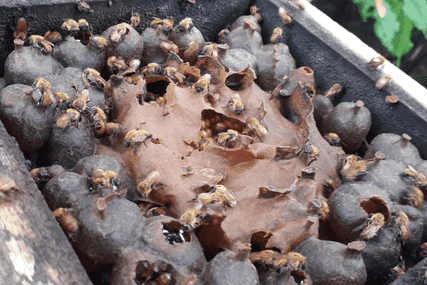
Jhonny Cuellar Nuñez was 12 years old when he first saw a colony of little stingless bees. He did not know they were called Tetragonisca angustula, nor that there was a word for the activity to which he would eventually dedicate his life. He only knew that these tiny insects sparked a curiosity he would not easily let go of.
Today, from his one-hectare farm in Piamonte, Cauca—in southeastern Colombia, on the edge of the Amazon—Jhonny works with 27 species of native bees and more than 600 colonies. What began as the intuitive capture of wild colonies has evolved into Mundo Amazónico, a business that produces honey, propolis, and bee nuclei, while seeking to change the productive model of a region long shaped by cattle ranching and illicit crops.
.png)
.png)
A Path Without Manuals
The process was far from straightforward. After his first experiences with stingless bees in Nocaima, Cundinamarca, his family moved to Bogotá, where keeping bees was impossible. When he arrived in Piamonte in 2009, Jhonny had to start from scratch—and discovered something unexpected: a municipality covering 1,100 square kilometers with a diversity of social bees he had never seen before.
“I arrived, as we say here colloquially, with nothing but the clothes on my back,” he recalls.
What he found was a territory marked by heavy deforestation and, hidden among the remaining trees, dozens of native bee species waiting to be rescued. He began capturing them, relocating colonies at risk, and accepting donations from neighbors who did not know what to do with them. Colony by colony, he built what is now a collection of 27 species across 11 to 13 different genera.
His training was largely self-taught. For years, there was almost no information online about meliponiculture (the keeping of stingless bees) in Colombia. A phone call to a colleague in Antioquia—who sent him hive box measurements via WhatsApp—helped him modernize and standardize his operation around 2016 and 2017. Today, most of his colonies are managed using technical hive systems.
.png)
A Real Economic Alternative to Cattle Ranching
When Jhonny arrived in Piamonte with his bees, his neighbors thought he was wasting his time. Years later, those same neighbors ask him how they can keep a colony at home.
The shift in perception is backed by hard numbers. The production model he has developed—100 colonies in a space measuring 6 by 18 meters—can generate between 50 and 100 million Colombian pesos per year, equivalent to approximately €22,000 to €25,000. In a region where a family of four can live on about one million pesos per month, that represents four to five times the typical household income.
The comparison with cattle ranching is striking. In a neighboring department, more than four million hectares of forest have been cleared to make way for cattle. According to Jhonny’s estimates, those lost forests contained more than 40 million wild bee nests—and with them, a productive potential that no one recognized in time.
Mundo Amazónico’s goal is to bring this model to the agricultural frontier: encouraging farmers who might otherwise clear forest for cattle to see native bees as a more profitable, more sustainable alternative that preserves existing ecosystems.
“Anyone who keeps bees is obligated to conserve,” says Jhonny. “When a neighbor cuts down trees, it hurts, because that means less food for the bees.”
.png)
Honeys Yet to Be Discovered
Part of the potential lies in the product itself. Honey from native stingless bees is radically different from the honey produced by Apis mellifera that is commonly sold in supermarkets.
Some varieties are intensely citrusy, others have fruity flavors, some are very sweet, while others have pronounced acidity. The texture is also different: whereas conventional honey contains around 18% moisture, these honeys can range from 25% to 50% moisture content, making them much more liquid and giving them a completely distinct character.
This higher moisture content also requires special handling. Without proper treatment, the honey can ferment. Managed correctly, however, these products have real gastronomic potential—some work as natural vinaigrettes, while others can be used as ingredients in fine dining cuisine.
.png)
Knowledge Meant to Be Shared
In addition to producing bee products, Jhonny and Mundo Amazónico have developed their own techniques and share them freely. One of the most significant innovations is an ant barrier that reduced ant attacks from five or six incidents per month to zero—a major problem that causes considerable losses in stingless bee operations.
These innovations are shared on TikTok and YouTube, guided by a simple philosophy: knowledge is useless if it is kept to oneself.
The local school now has an active meliponary where students learn about native bees. Teachers have become capable of passing on the knowledge independently. Some students graduate with an interest in bees; others choose cattle ranching. But at least now they are making informed decisions.
In Colombia, it is estimated that 90% of the population does not know that stingless bees exist. In Europe, that percentage is probably even higher. Yet while awareness slowly spreads, the work is already underway: on a single hectare in Piamonte, Cauca, Jhonny Cuellar Nuñez has spent years demonstrating that conserving the forest and making a decent living from it are not contradictory goals.
All it takes is the right bees and knowing how to listen to them.
.png)