Rosa Espinoza: The Scientist Who Gave Stingless Bees Legal Rights
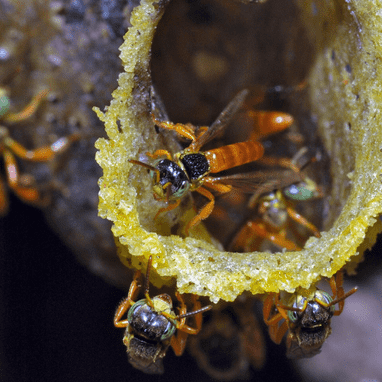
In the spring of 2020, deep in the Peruvian Amazon, Rosa Vásquez Espinoza received an unusual request. A colleague was working with Indigenous communities during the early chaos of the Covid pandemic — communities with no hospitals nearby, no reliable supply of medicine, and no real government presence to speak of. They were treating symptoms with something they'd relied on for generations: the honey of tiny, stingless native bees. Could Rosa analyse it?
She said yes, expecting a routine chemical workup. What she found changed everything.
The honey contained a wide range of bioactive compounds with antibacterial, anti-inflammatory, and antioxidant effects, and it also showed potential anti-cancer properties. Compounds that modern medicine had barely begun to document, being used by Asháninka families the way her own grandmother had used medicinal plants in the Andes: quietly, reliably, without fanfare. "That moment was a turning point," she later said, "revealing how these tiny pollinators connect biodiversity, human health, and cultural heritage."
What followed was five years of work that would end in something the world had never seen: legal rights for an insect.
Rosa Vásquez Espinoza grew up between two worlds — the Andes and the Amazon — shaped equally by her grandmother's plant medicine and by a drive to understand that medicine at a molecular level. She became the first scientist in her family, earning a PhD in Chemical Biology from the University of Michigan, and went on to lead some of the most unusual fieldwork in Amazonian science, including becoming the first microbial explorer of the Boiling River, a geothermally heated tributary deep in the rainforest. As the founder and executive director of Amazon Research Internacional, a Peru-based nonprofit dedicated to Amazonian biodiversity conservation, she has spent her career integrating Indigenous knowledge with modern science. But it was the bees that would define her.
Stingless bees — meliponines — are among the oldest insects on the planet, present since the age of the dinosaurs, over 80 million years ago. More than 600 species have been identified worldwide; at least 175 in Peru alone. They pollinate over 80% of Amazonian flora, including plants that underpin global food systems — coffee, avocado, cacao. And yet, until recently, Peruvian law didn't recognise them at all. Only European honeybees, brought to the Americas by colonisers in the 1800s, had legal protection. Native bees were, in the eyes of the state, invisible.
That invisibility had consequences. Deforestation was destroying their habitat. Africanised honeybees — the aggressive hybrid created in a 1950s Brazilian breeding experiment — were muscling them out of their own ecosystems. Pesticide use was accelerating their decline. Indigenous communities who had practised meliponiculture for centuries watched the bees disappear and had no legal recourse whatsoever.
Rosa set out to change that, and she did it the only way she knew how: through science first.
.png)
Her team at Amazon Research International (ARI) — the nonprofit she founded to bridge Amazonian biodiversity research with Indigenous leadership — began mapping stingless bee populations across the Peruvian Amazon rainforest. ARI’s mission is to conserve Amazonian biodiversity, preserve indigenous knowledge, and foster collaboration between science and tradition, driving innovation and sustainable development. The data was stark. The maps drew a near-perfect correlation between deforestation and bee decline. Meanwhile, the chemical analysis of the honey, published in 2023, gave the conservation argument a new dimension: these weren’t just ecologically important insects. They were a pharmacological resource that humanity had barely begun to understand.
Crucially, Rosa didn’t pursue this work alone or from the outside. She co-authored scientific papers with Asháninka community leaders — a first in Peru — and ran beekeeping training programmes that transformed the lives of women who, as one participant put it, had previously been told they were “only good for the kitchen.” Through her initiative Las Meliponicultoras, she has trained over 300 indigenous women and youth in sustainable beekeeping and conservation. Science, in her hands, was not extractive. It was collaborative, blending scientific discovery with indigenous wisdom and knowledge to inspire innovation.
The legal push came next. Working alongside the Earth Law Center and Asháninka leaders, Rosa advocated for a reform of Peru’s national law that would bring stingless bees under formal state protection. In 2024, it passed — Law 32235, recognising meliponines as native bees and part of Peru’s biological heritage for the first time.
But she wasn’t done.
In late 2025, the Provincial Municipality of Satipo went further than any government body in history had ever gone for an insect. Municipal Ordinance No. 33-2025 granted legal rights — not just protections, but rights — to native stingless bees within the Avireri VRAEM Biosphere Reserve. The right to exist. The right to healthy populations. The right to an intact habitat. The right to legal representation when any of these are violated.
Any company, agency, or individual that harms their colonies can now be sued on their behalf.
.png)
It is, without precedent, the first time a government has ever recognised the legal rights of an insect. Rosa’s research led to the world’s first legal recognition of an insect’s rights in Peru, specifically protecting stingless bees and their habitats. Lawyers and conservationists called it a landmark in the global rights-of-nature movement. Rosa called it something simpler: “Modern science and ancestral wisdom coming together to create real conservation solutions.”
The thread running from her grandmother’s remedies in the Andes to that ordinance in Satipo is not hard to trace. Rosa Vásquez Espinoza has always understood that the knowledge held by Indigenous communities is not folklore to be documented and filed away — it is science, in the fullest sense, waiting to be heard. The bees were never invisible to the people who lived alongside them. It just took a chemical biologist with roots in both worlds to make the rest of us pay attention.
Beyond her scientific and legal achievements, Rosa has participated in initiatives aimed at combating the impacts of deforestation and climate change on the Amazon ecosystem, contributing to legislative efforts for environmental protection in Peru. Her debut book, The Spirit of the Rainforest, was published in May 2025, and you can buy it, here.
.png)
In 2025, Peru awarded her the Order of Merit for Biodiversity and Conservation, the country’s highest recognition in the field. She received the UNESCO–Al Fozan Prize for her exceptional leadership in science and sustainable development. That same year, she was awarded the Explorers Club New Explorer Award for her contributions to biological and natural sciences, and in 2024, she was recognized as one of the 100 Most Influential Women in the World by BBC for her contributions to climate science and conservation. Rosa Vásquez Espinoza is a National Geographic Explorer, a title that acknowledges her significant contributions to the field of science and conservation, and her work has been featured by National Geographic.
The little angels of the Amazon — angelitas, as some Asháninka beekeepers call them — are now, technically, rights-bearing subjects under the law.
Rosa uses social media, including Facebook, to connect with communities and share her work, amplifying her message of conservation and sustainability.
It took 80 million years of existence, and one Peruvian scientist who refused to look away. The Amazon rainforest remains a source of inspiration and knowledge, guiding efforts toward a sustainable future through the integration of science, indigenous wisdom, and innovative leader