The Role of Stingless Native Bees in the Amazon
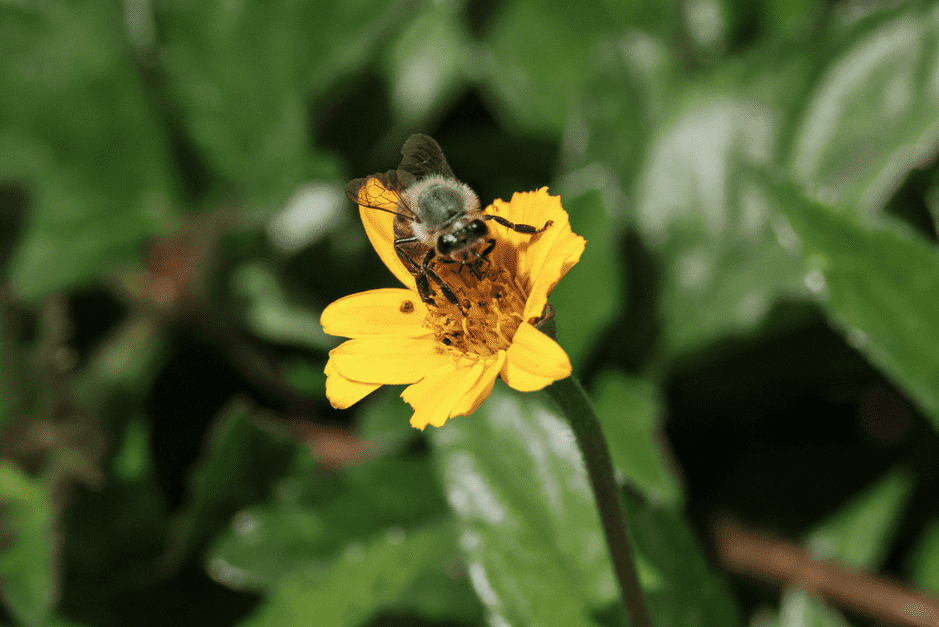
For centuries, stingless native bees have lived quietly in the tropical forests of Latin America. Without a stinger, with a unique biology and a deep connection to the ecosystems they pollinate, these bees remained largely unknown outside their regions of origin. That is now beginning to change.
Today, stingless bees are attracting growing attention—not only for the distinctive qualities of their honey, but also for their potential to support rainforest conservation and strengthen local livelihoods.
To better understand this growing interest, we spoke with Daniel López, a Spaniard who has spent nearly two decades living and working in the Peruvian Amazon. Daniel has dedicated his work to promoting sustainable rural development alongside Indigenous and rural communities.

An unexpected encounter with stingless bees
Daniel arrived in Peru almost 20 years ago to work on international cooperation projects focused on improving living conditions in Amazonian communities. His work has consistently revolved around alternative rural development, natural resource management, and the search for sustainable economic activities.
Around 2010, almost by accident, he was introduced to stingless native bees. At the time, they were virtually unknown—even to him. “I didn’t even know they existed,” he recalls. Still, meliponiculture was included as an experimental activity within a broader ecotourism and natural resource management project run by the NGO Green Life in the community of Yarina, located inside the Pacaya Samiria National Reserve.
Information on how to rear native bees was scarce. Early efforts were largely empirical: trial and error, hands-on learning, and close collaboration with the community. Although the Green Life project in Yarina did not continue, the experience left a lasting impression on the team involved.
Building on that experience, a small group of colleagues and friends—captivated by these bees—continued promoting meliponiculture in communities along the lower Nanay River near Iquitos. With additional training in Mexico and Brazil, the practice gradually became more structured. Support from organizations such as La Restinga, Green Life, One Planet, and Chaikuni helped expand the initiative across the Loreto region.
.png)
.png)
In 2018, Daniel joined the Chaikuni Institute, where meliponiculture has since become a central activity within a broader framework of permaculture and agroforestry.
What makes Meliponines so special?
Stingless native bees belong to the tribe Meliponini and differ significantly from the European honeybee (Apis mellifera). While they also produce honey, wax, and pollen, their biology and behavior are distinct.
Instead of building hexagonal honeycombs, meliponines store food in small oval containers—known as “pots”—which are clearly separated from the brood areas. Their honey is more liquid, with a higher moisture content and a wider range of complex flavors.
Because of its high water and sugar levels, melipona honey ferments naturally. This fermentation does not make it unsafe, but it does change its properties, giving it a characteristic acidic taste. In Amazonian communities with a long tradition of honey harvesting, fermented honey is commonly consumed. However, for high-quality production, careful harvesting and storage are needed to limit fermentation.
Distribution and local species
Melipona bees are primarily found in tropical and subtropical regions. In Peru, their greatest diversity is concentrated in the Amazon, although species can also be found in the northern tropical dry forests and at elevations of nearly 2,000 meters.
Daniel and the Chaikuni team mainly work with species from the Melipona genus, including Melipona eburnea, Melipona iliota, Melipona crinita, and Melipona grandis. These species adapt well to box hives and offer relatively good honey yields.
In areas where deforestation has reduced biodiversity, the team works with more generalist species such as Tetragonisca angustula, known locally as ramichi and elsewhere as angelita, virgencita, mariola, or chumelo.
A core principle of the work is to use only local species. Introducing bees from other regions can disrupt ecosystems and put native populations at risk.
Ancient knowledge and traditional uses
While the Mayan relationship with melipona bees is well documented, less attention has been paid to the deep connections between native bees and Amazonian cultures. Although no formal ancestral beekeeping systems like those of the Maya have been recorded, Indigenous communities in the Amazon have relied on wild native bees for centuries.
These communities possess extensive knowledge of local species and the medicinal properties of their products. Honey and pollen are traditionally used to treat colds, intestinal infections, and infertility. In parts of Latin America, honey from certain species is even used to treat eye conditions such as conjunctivitis and allergies, applied directly as drops.
These practices form part of a living tradition of natural medicine—one that is now attracting growing interest from researchers and health professionals.
Why is there an interest in Melipona Bees suddenly?
Several factors are driving renewed interest in stingless bees. There is increasing awareness of the crucial role bees play in biodiversity and ecosystem health. At the same time, many organizations and rural communities see meliponiculture as a low-cost, sustainable source of income that does not rely on external technologies.
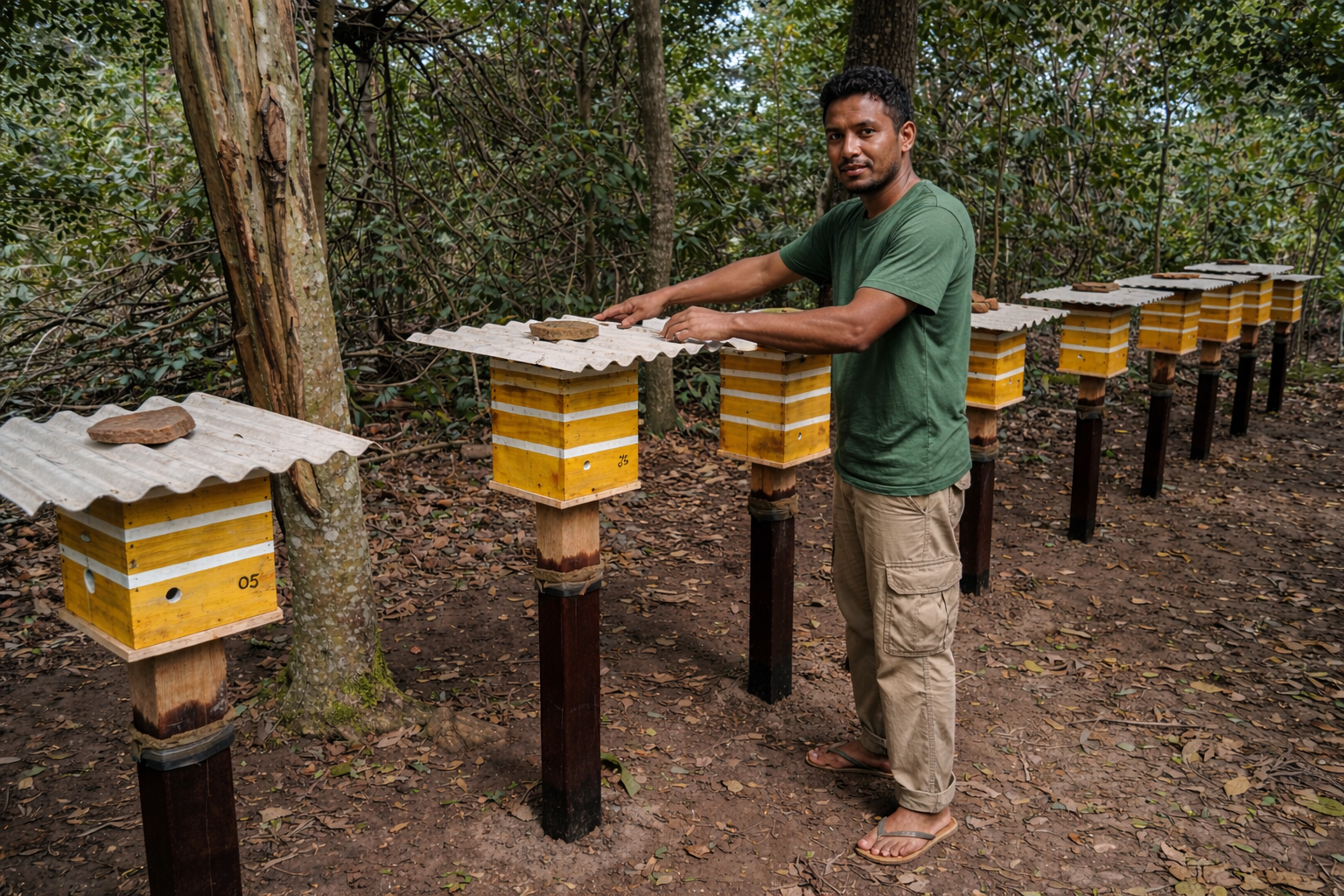
Communities can build their own hive boxes, consume honey locally, and sell surplus production without depending on large commercial supply chains. When production becomes stable and high quality, melipona honey can access niche, high-value markets.
While Apis mellifera can produce around 40 kilograms of honey per hive per year, meliponine colonies typically yield just two to three kilograms. This scarcity—combined with cultural significance and medicinal value—makes melipona honey a premium product.
Conservation, not panic
Most stingless bee species are not officially classified as endangered. However, Daniel notes that deforestation, agrochemical use, and the overharvesting of wild nests are reducing both their abundance and diversity.
At the same time, in well-preserved forests, melipona populations remain strong. Their presence is a clear indicator of ecosystem health.
Meliponiculture as part of a bigger picture
At Chaikuni, meliponiculture is not viewed simply as an income-generating activity. It is part of broader agroforestry systems designed to strengthen community autonomy, diversify livelihoods, and deepen relationships with the natural environment.
Training plays a central role. Participants receive hands-on instruction at the experimental center and then apply what they learn in their own communities, adapting techniques to local conditions. Families involved in the program receive ongoing technical support to monitor hive development and address challenges as they arise.
“The learning process never really ends,” Daniel explains. “No matter how much you know, you’re always learning. The best teachers are the bees themselves. Training and reading are important, but above all, observation—learning to understand what’s happening inside each colony.”
Future challenges
The Amazon faces growing threats. Forest fires driven by agricultural expansion and climate change, along with illegal mining, drug trafficking, and violence against environmental defenders, are putting both ecosystems and communities at risk.
In this context, meliponiculture is not a silver bullet. But it is an important piece of a broader approach to conservation and social justice—one that places communities at the center.
Small bees, big impact
Melipona bees remind us that meaningful solutions don’t always come from large-scale infrastructure or complex technologies. Sometimes, protecting the forest begins with valuing local knowledge, supporting practices rooted in place, and standing alongside the communities who have lived in balance with nature for generations.
At melipona.eco, we believe that sharing these stories is a vital step toward building bridges between science, tradition, and collective action.