When Education Saves Bees and Transforms Lives
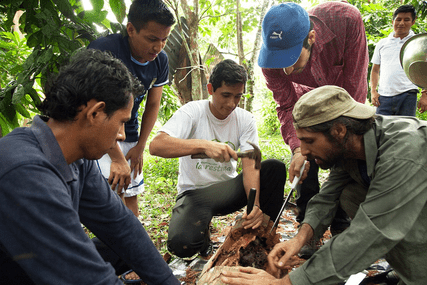
Getting an interview with Carlos García can feel like trying to track down Indiana Jones: he's almost always off the grid, somewhere deep in the jungle or out on a river in the Amazon. But it wasn't always this way.
More than fifteen years ago, this Spaniard from Córdoba landed in the Peruvian Amazon with a thesis in hand and the restless energy of someone determined to experience firsthand what he'd only ever read about. At the time, stingless bees were poorly understood — Carlos himself had classified them as pests in his thesis. These native species, unlike common honeybees, cannot sting, but their mandibles damaged certain fruits, making them impossible to sell. Today, he has dedicated his life to protecting them and teaching indigenous communities how to raise them sustainably.
.png)
From the books to the jungle
Carlos arrived in the Amazon in 2008, when little was known about stingless bees, and his understanding deepened as he built relationships with local communities and researchers like Daniel López and David Cecchi, pioneers in native bee cultivation in the region.
In 2010, he took part in pilot projects in the Pacaya Samiria National Reserve alongside López and Cecchi. That experience led them to the Allpahuayo-Mishana National Reserve, where they discovered that communities were already familiar with native bee honey — but the way they harvested it was unsustainable. The idea took shape: teach people to raise bees without destroying the nests.
The challenge, though, went beyond beekeeping. Decades of outside projects had left a lasting mark: many communities had come to expect handouts whenever an external organization showed up. Carlos and his colleagues at Asociación La Restinga chose a different approach — not giving, but teaching. Not fixing, but empowering.
.png)
Give a man a fish, and he eats today. Teach him to fish, and he eats for a lifetime.
In the Amazon, the word "project" carries particular baggage: donations, outside money, and promises that collapse when the funding dries up. For decades, communities had been passive recipients of initiatives that arrived with fanfare and faded without a trace.
The idea was born at Asociación La Restinga, a community organization based in Loreto where Carlos worked. The early years were tough: a Canadian company promised funding that did come through, but with very little behind it, and Carlos and David Cecchi kept the project alive for years on what amounted to volunteer work. Eventually, One Planet — an international organization focused on sustainable development in vulnerable communities, which had already tried and failed to launch a conventional beekeeping program in the area — came looking for them to pick up where things had stalled. Together with Camino Verde, an organization dedicated to reforestation and sustainable development in the Peruvian Amazon, they produced a series of video tutorials distilling years of work alongside Maijuna indigenous communities in the Loreto region. But the underlying goal had never changed: not to hand out hives or spread resources around, but to train, teach, and build lasting self-sufficiency from the ground up.
The school took root in the Maijuna community of Sucusari. It started with children, who came to the bees with natural curiosity — no fear, no preconceptions. Each family was required to keep a hive at home in order to attend. And so parents who had looked on with skepticism gradually, almost without realizing it, got drawn in.
Knowledge spread through the community the way bees spread resin to seal their nests: slowly, but with a hold that lasts.
.png)
A real economic alternative
Amazonian communities live with a constant tension: they need income for everyday essentials — medicine, school supplies, fuel — but the available options usually involve extractive work that depletes the land around them.
Meliponiculture offered something built on an entirely different logic: a practice that replenishes rather than takes. It requires no deforestation, no destruction of nests, and fits naturally alongside traditional ecological knowledge. And it produces something genuinely valuable: medicinal honey that commands strong prices in both domestic and international markets.
Unlike conventional beekeeping, raising native bees requires no protective gear or invasive techniques. These species have been part of the Amazonian ecosystem for millennia, shaped by and fully adapted to it.
Over time, a number of families began earning stable annual incomes. But the effects reached well beyond money.
.png)
From learning to teaching
After nearly a decade of sustained training, certain participants rose to the surface — people with a gift for leadership and for passing on what they'd learned. They became community promoters: people capable of spreading meliponiculture not just within their own communities, but across the wider region.
.png)